Fred Gray has a warning for the Miami startup ecosystem. Miami has the activity, he wrote on LinkedIn, but the flywheel is still missing.
Gray is Head of Primary VC Research at Crunchbase. His post made three claims. Deal volume rose 79%, venture dollars fell 5%, and capital imported from other ecosystems grew 21%. He added that Miami ranks at or near the bottom on all eight indicators in Crunchbase’s ecosystem health score.
MAIN asked him to talk it through. Since then, a fresh Crunchbase extract has changed parts of the story.
The Numbers Behind the Post
The data comes from a Crunchbase extract dated October 12. It compares 2016-2018 with 2023-2025 across eight selected hubs.
Miami’s round count grew about 64%, the fastest of the eight. Its recorded capital ranks seventh of the eight, and its median disclosed round, $1.75 million, is the smallest.
Progression is where Miami looks weakest. About one in six Seed companies from the 2019 cohort reached Series A within three years. Miami ranks sixth of eight on both stage jumps, and last on acquisitions and IPOs.
MAIN has covered both sides of this gap. MAIN Data found that Miami startups raised $400M in Q3 2026. Joshua Siegel told MAIN that early-stage money is still thin.
Crunchbase describes Miami’s ecosystem score of 31.1, eighth of eight, as provisional. Re-estimates land near 31 to 32, but they are sensitivity models, not an official Crunchbase score.
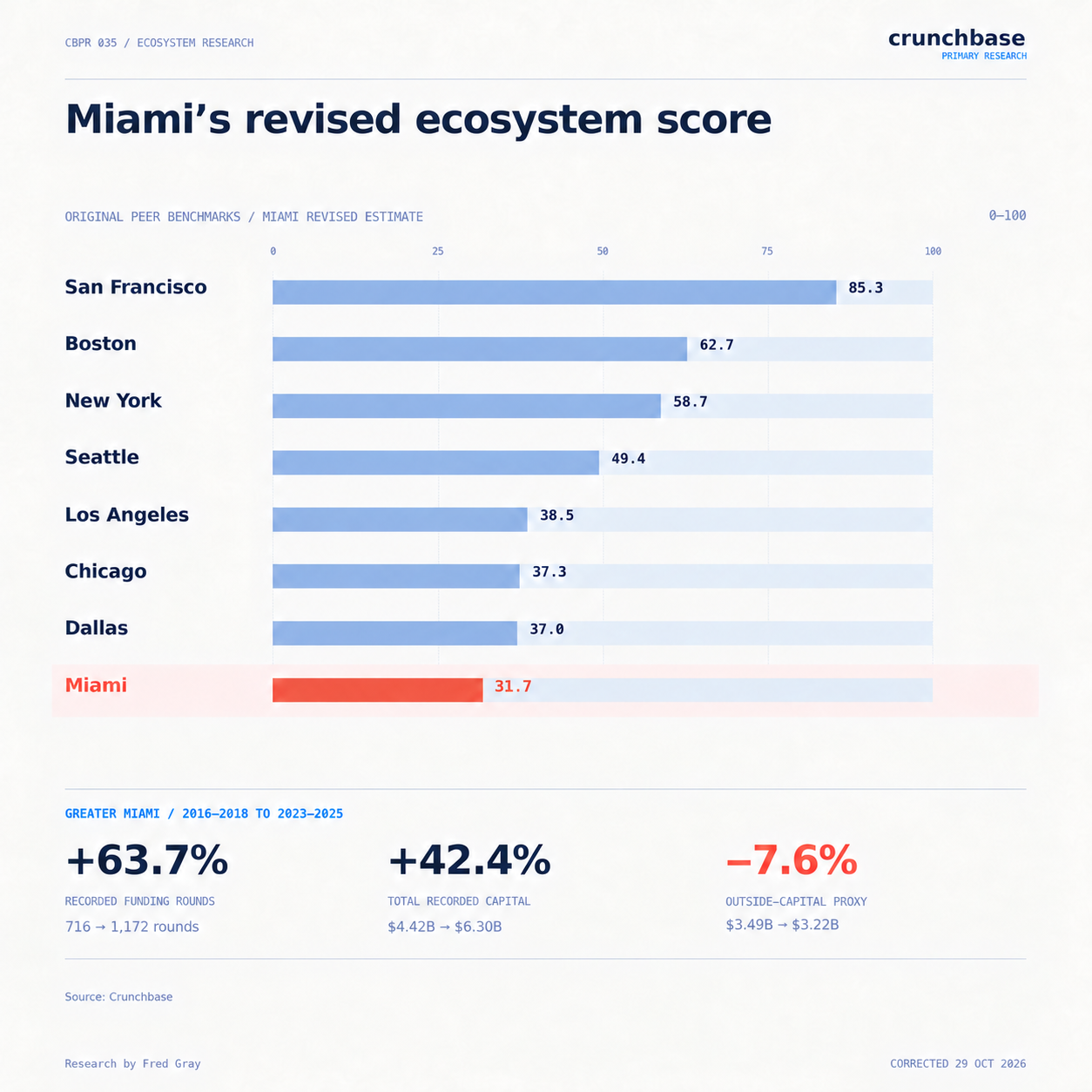
Crunchbase chart: Miami’s revised ecosystem score, corrected October 29, 2026. Source: Crunchbase.
Gray’s answers below should be read against that backdrop.
This is part of a peer-to-peer series of conversations MAIN runs with the founders, investors and analysts shaping Miami’s tech ecosystem. We asked Gray a handful of questions in writing. His answers, lightly edited for length, are below.
Is “growing fast, graduating slowly” a fair read of Miami?
Miami grew round count faster than any of the eight hubs. It ranks sixth or lower on seed-to-A, A-to-B and exits. The question was whether a younger cohort explains the gap.
“Yes, directionally. My read is that Miami has demonstrated it can attract founders and generate funding activity. It has more to prove when it comes to consistently turning that activity into companies that scale and exit.
The younger ecosystem argument deserves consideration, especially for the recent wave of companies. But it doesn’t fully explain the historical progression gap because we compared companies that raised in the same year and gave them the same time to advance. I see Miami as an ecosystem with real momentum whose next test is converting that momentum into durable outcomes.”
Every hub got the same window, which is why age alone does not close the gap.
One detail from the data: Miami’s seed-to-A rate beats Chicago and Dallas. Last place is not the whole story.
Is Miami a small-round ecosystem by design or by constraint?
“I lean toward an ecosystem that is still building depth. Small rounds aren’t inherently a weakness; a healthy startup market needs plenty of early experimentation. The concern is whether promising companies can reliably find the larger rounds that come next. The median alone doesn’t prove a shortage of local lead investors, but it makes follow-on funding an important question.”
Who is leaving, or is the outside-capital decline a denominator artifact?
The proxy shows outside-organizational allocations declining. Gray would not turn that into a story about investors fleeing.
“I wouldn’t make this an ‘investors are leaving Miami’ story. The missing investor information is substantial enough to change that conclusion.
The clearer takeaway is that our proxy still points to a large role for investors based elsewhere. For Miami, building strong connections to national capital matters alongside building its local fund community. The real test is whether good companies can keep attracting investment as they grow.”
The proxy covers only the largest rounds, so missing data limits what it can say.
If a Miami founder reads one number, which should it be?
“Roughly one in six: 16.4% of the recorded Seed cohort reached Series A within three years. That isn’t a prediction for an individual founder, but it puts the challenge in perspective. My takeaway is that raising the first round is only the beginning. Founders should be just as deliberate about what that capital needs to accomplish before the next raise.”
The cohort is small, and the analysis says so. Gray offers the figure as perspective, not prophecy.
What should the Miami startup ecosystem track next?
“I’d track AI companies funded, stage mix, investor participation, and disclosed capital, showing how much funding depends on the largest deals. Keep ‘Miami’ and ‘AI’ consistently defined and check every headline calculation.”
Fred Gray is Head of Primary VC Research at Crunchbase. Learn more at www.crunchbase.com.
Sources: 1. Fred Gray Q&A with MAIN, written answers 2. Crunchbase extract dated October 12, 2026 (Miami journalist analysis workbook) 3. Crunchbase infographic, “Miami’s revised ecosystem score is provisional,” corrected October 29, 2026 4. MAIN Data: Miami Startups Raised $400M in Q3 2026 5. MAIN Exclusive: Joshua Siegel on Miami’s Tweener Stage Gap 6. Crunchbase