The AI boom has created an unusual financial paradox.
The companies spending the most on artificial intelligence are also beginning to demonstrate that the spending is generating real demand. Cloud backlogs are surging, hyperscaler revenues are growing and businesses continue to commit billions to computing capacity.
But paying for that expansion is becoming more expensive.
Alphabet, Amazon and Meta have already issued almost $220 billion of bonds this year, more than double their full-year total from 2025, according to LSEG data cited by Reuters. Across Alphabet, Amazon, Microsoft and Meta, AI-related capital expenditure is projected to reach roughly $725 billion to $760 billion in 2026.
And the cost of capital is rising at exactly the moment these companies need enormous amounts of it.
The AI Boom Needs A Lot Of Money
The market has largely accepted the argument that AI infrastructure spending will eventually translate into enormous revenues.
There are signs that is beginning to happen.
Microsoft's Azure cloud business has surpassed $100 billion in annual sales. Amazon Web Services grew 36.7% in its latest quarter, its fastest growth in 18 quarters, while Alphabet is also reporting strong cloud growth.
The four major cloud providers now have more than $2.3 trillion in combined cloud backlogs, according to Bank of America research cited by Yahoo Finance.
That is the bullish case: demand for AI computing is growing faster than infrastructure can be built.
But there is another side to the equation.
Alphabet, Amazon, Microsoft and Meta are collectively expected to spend hundreds of billions of dollars this year building the computing infrastructure required to meet that demand. Much of the investment has to be made before the eventual revenue arrives.
That makes interest rates unusually important.
Higher Rates Change The AI Calculation
AI companies and hyperscalers are effectively making enormous bets on future cash flows.
When interest rates are low, investors are more willing to assign high valuations to businesses whose biggest profits may arrive years from now.
When rates rise, those future profits become less valuable in today's dollars.
The problem is compounded when the companies themselves are borrowing heavily to fund the infrastructure.
U.S. 30-year real yields are around 3%, close to an 18-year high, while the U.S. recently paid a 5.22% yield on a 30-year Treasury auction, the highest borrowing cost at such an auction since 2001, according to Reuters.
The AI industry is therefore competing with governments and other borrowers for a finite pool of capital.
That competition could become one of the biggest constraints on the next phase of the AI buildout.
The Bottleneck Is Moving
For much of the AI boom, the dominant infrastructure constraints were chips and memory.
Now another bottleneck is emerging: capital.
The companies building AI infrastructure need semiconductors, electricity, data centers, networking equipment and cloud capacity. They also need the money to pay for all of it.
That creates a chain reaction.
More AI demand means more infrastructure.
More infrastructure means more capital expenditure.
More capital expenditure means more borrowing.
More borrowing can put upward pressure on bond yields.
And higher yields increase the cost of financing the next generation of AI infrastructure.
That doesn't necessarily stop the boom. But it changes its economics.
The AI Trade Is Becoming A Returns Question
The first phase of the AI investment story was about belief.
The second was about spending.
Now the market is beginning to demand evidence of returns.
That evidence is emerging in cloud revenue and enormous backlogs. But the spending required to capture that demand is also creating a financial vulnerability.
Wall Street may therefore be approaching a more complicated phase of the AI boom: one where AI demand is no longer the only question.
The bigger question is whether the economics of building the AI economy can keep up with the cost of financing it.
What This Means For Miami
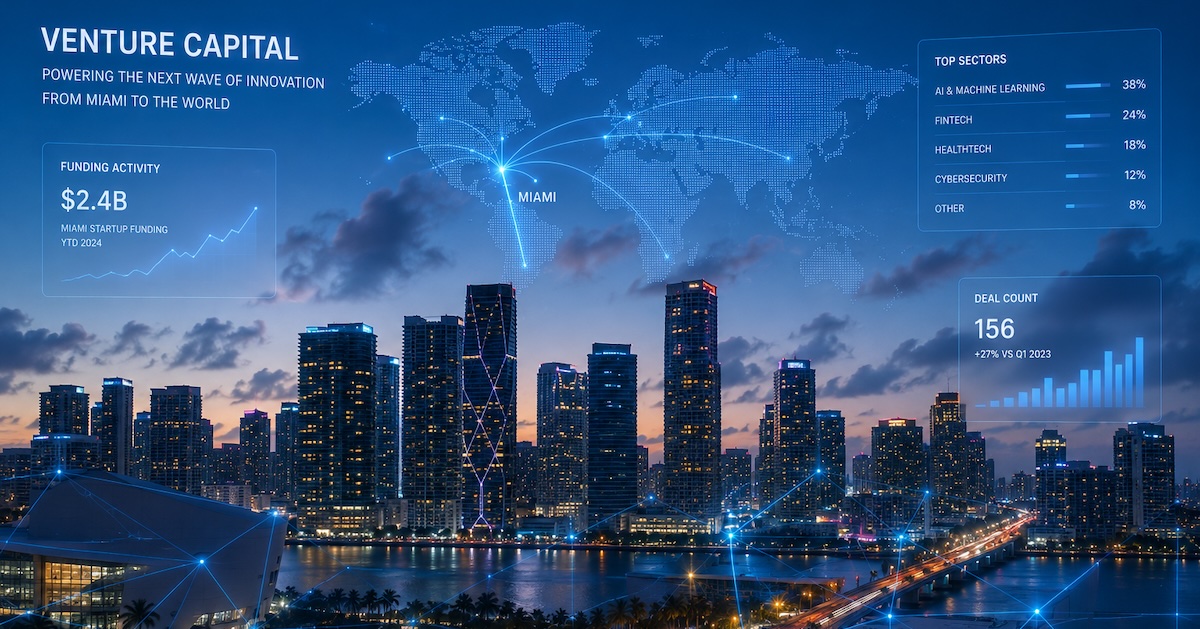
Miami is particularly relevant to this story because South Florida is trying to position itself as an AI and technology hub while also competing for data centers, infrastructure investment and technology companies.
The financial question matters because the AI economy isn't built solely by software startups.
It requires physical infrastructure.
Data centers need power. Power infrastructure needs investment. Cloud providers need facilities and networking equipment. Companies building those facilities need access to increasingly expensive capital.
That means Miami's AI ambitions are tied to the same capital cycle now being watched by Wall Street.
If AI revenues continue growing rapidly, the higher cost of capital may simply become another cost of building the infrastructure required for that growth.
If returns disappoint, however, financing costs could become a much bigger constraint.
For South Florida, that makes the next phase of AI development less about simply attracting companies and more about whether the region can provide capital, power, infrastructure and customers at competitive costs.
Reporting Source: This article builds upon reporting from Bloomberg, Yahoo Finance and Reuters and adds analysis of what the development means for Miami and South Florida.