The artificial intelligence boom is creating an increasingly interconnected financial system, with some of the world's largest technology companies making substantial investments in the same AI companies that are helping drive the market's growth.
That creates a potential vulnerability.
Recent results from Amazon and Alphabet show that investment gains are becoming a significant contributor to reported profits. Those gains are tied in part to stakes in AI companies, meaning the fortunes of major technology companies are becoming increasingly dependent on the valuations and success of other companies within the same AI ecosystem.
The issue is not necessarily that the investments are bad. It is that the same companies, capital and expectations are appearing repeatedly throughout the AI investment chain.
As Matt King, founder of financial markets research firm Satori Insights, put it: “It’s circular. What’s funding A.I. is now increasingly more A.I.”
AI investment gains are becoming a major source of profits
According to analysis cited by The New York Times, investment gains accounted for roughly 65% of Amazon's second-quarter net income, with the majority coming from its stake in AI company Anthropic.
Alphabet's numbers were even more striking. More than 70% of its quarterly net income came from investments in other companies, with its stake in SpaceX, which has both space and AI interests, playing a major role.
Alphabet reported nearly $80 billion in pretax profit from investments in restricted equity securities and disclosed holdings of approximately $94.1 billion in SpaceX shares.
These are not necessarily cash profits generated by selling products or services. Unrealized investment gains are reflected in accounting when the value of a company's holdings rises.
That distinction matters.
If the value of those investments falls, the same mechanism can work in reverse and reduce reported earnings.
The result is that a company's financial performance can increasingly be influenced not only by how well its own businesses perform, but also by how investors value the AI companies in which it holds stakes.
The Magnificent 7 are increasingly exposed to the same AI cycle
The concentration becomes more apparent when looking across the technology giants collectively.
The seven companies commonly known as the Magnificent 7 generated approximately $315.6 billion in combined net profit during the second quarter, according to the analysis cited by the Times.
Of that amount, approximately $134.6 billion, or 42%, came from investment gains.
That was a substantial increase from the previous quarter, when investment gains represented only around 5% of the group's overall profits.
Without those investment gains, the group's profits would have been roughly flat compared with the previous quarter, according to the analysis.
Not every company in the group reported comparable investment income. Microsoft, Meta, Apple and Tesla did not report similar investment gains, while Nvidia reported approximately $13 billion in investment gains during its latest quarter.
Nvidia's investments include stakes in OpenAI and Anthropic, as well as AI infrastructure companies such as CoreWeave and Applied Digital.
This creates an ecosystem in which the companies building AI models, supplying chips, operating cloud infrastructure and providing capital can also be investors in one another.
The AI financing cycle can reinforce itself
The circularity goes beyond stock-market valuations.
Major technology companies and investors are providing capital to AI companies. Those AI companies then spend heavily on computing infrastructure, chips and cloud services.
The companies supplying that infrastructure can consequently benefit from the increased spending.
If the AI companies become more valuable, the investors holding their shares can record investment gains. Those gains can contribute to stronger reported earnings and support higher valuations.
That can make additional investment easier to justify.
The cycle can therefore reinforce itself as long as expectations continue rising.
The New York Times has previously reported on concerns surrounding these interconnected AI financing arrangements, including deals in which technology companies invest in AI businesses that subsequently spend money with technology companies elsewhere in the same ecosystem.
AI executives have defended the arrangements as a way of unlocking the enormous amounts of capital required to build increasingly expensive AI infrastructure.
But the financial exposure cuts both ways.
What happens if AI expectations change?
The key question is what happens if investors begin to doubt whether AI companies can ultimately generate enough revenue and profit to justify the enormous investment currently flowing into the sector.
The AI industry is undertaking one of the largest infrastructure buildouts in modern technology, requiring enormous spending on data centers, processors, electricity and networking.
If expectations remain strong, rising valuations can support continued investment.
If those expectations change, however, the same interconnectedness could accelerate the downside.
A fall in the value of AI companies could reduce the value of investment holdings. That could affect the reported earnings of companies that own those stakes. Falling earnings and valuations could then affect investor confidence and the availability of capital for AI infrastructure and startups.
Ajay Rajadhyaksha, global chairman of research at Barclays, described the broader exposure bluntly: “The A.I. trade is massively important to the U.S.”
He added that the country is “more exposed to the A.I. trade unwinding as an economy than we were even a few years ago.”
That is the larger issue behind the investment figures.
The question is no longer simply whether individual AI companies succeed. The question is how many other businesses, investors and financial assets have become tied to that success.
Why this matters beyond Wall Street
The AI boom is increasingly being treated as an engine of economic growth, rather than simply another technology investment cycle.
That makes the financial structure behind it important beyond investors in Amazon, Alphabet or Nvidia.
AI infrastructure requires huge amounts of capital. Data centers require land, power, construction, networking equipment and specialized chips. Startups require funding. Cloud providers require continued demand.
If AI investment continues producing strong returns, that capital can support further expansion.
But if expected returns fail to materialize, the consequences could extend well beyond the companies developing AI models.
The interconnected nature of the sector means that a decline in one part of the ecosystem can potentially affect companies elsewhere.
That does not mean a collapse is inevitable. The reporting does not establish that the current AI boom is fundamentally unsustainable. It does, however, show that the financial consequences of an AI downturn could be broader than they would have been when AI was a much smaller part of the technology and investment landscape.
What This Means For Miami
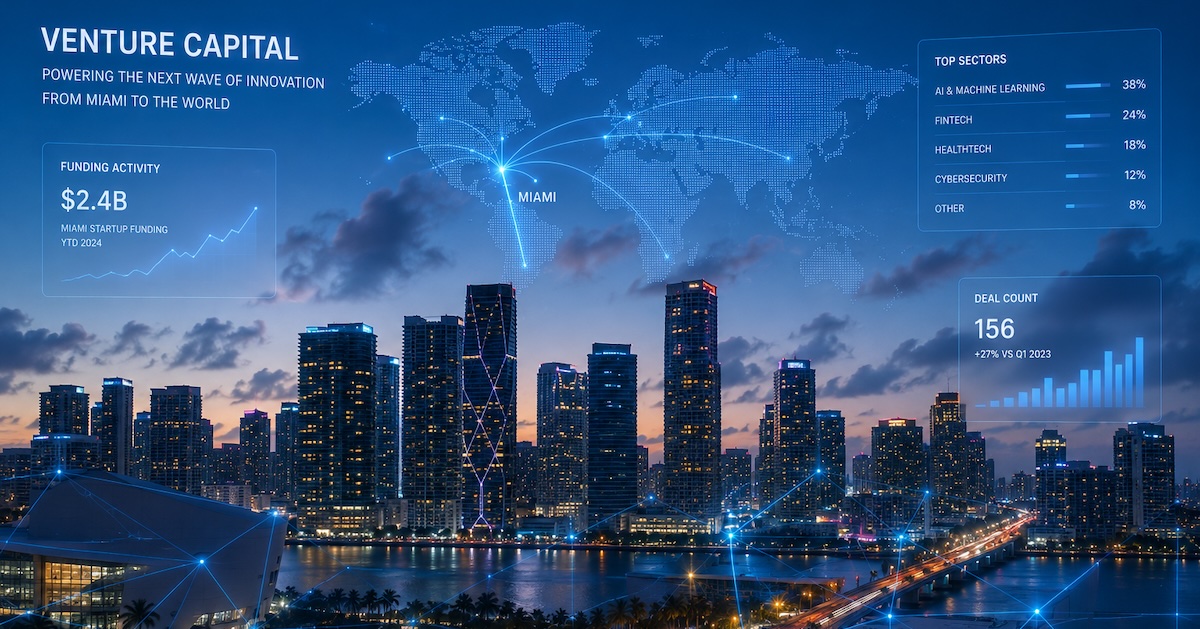
Miami is building a growing position in the AI economy, attracting startups, investors, technology companies and infrastructure projects.
That creates significant opportunities, but it also means Miami is becoming increasingly exposed to the broader economics of the AI cycle.
For Miami startups, a sustained AI investment boom means more available capital and a larger potential market for AI products and services. For investors and companies building around the sector, however, the growing interdependence of AI valuations, infrastructure spending and technology-company profits is an important risk to watch.
The lesson is not that Miami should step back from AI.
It is that the next stage of the AI economy will increasingly depend on real revenue, sustainable business models and productive use of infrastructure, rather than valuation growth alone.
Reporting Source: This article builds upon reporting from The New York Times and adds analysis of what the development means for Miami and South Florida.