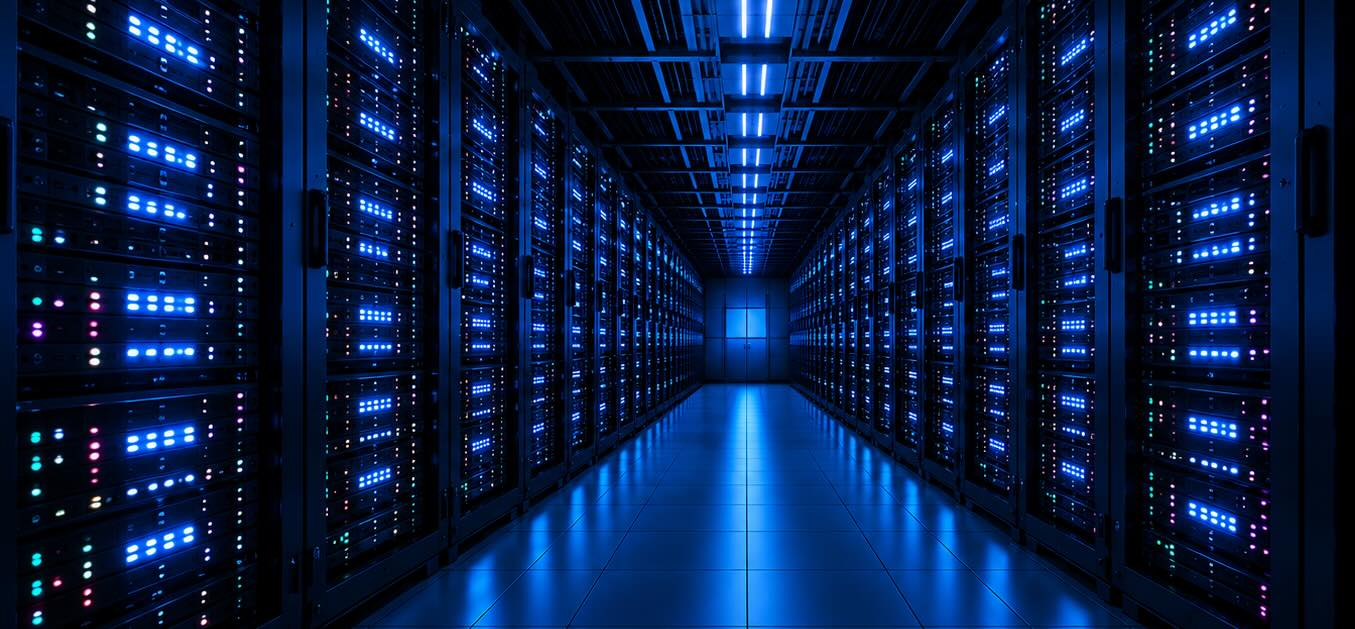
Nobody expected the data center to become a political flashpoint. Yet here we are. Across the country, communities are pushing back against new data center construction.
The complaints are consistent: electricity demand, water consumption, noise and land use, along with questions about how many permanent jobs facilities create once construction is complete.
Into that fight has stepped President Donald Trump, who has increasingly positioned himself as a vocal defender of the industry's expansion.
That's notable because opposition to data centers does not fit neatly into traditional political divisions. Residents in both Republican- and Democratic-leaning communities have challenged proposed facilities, often focusing on highly local concerns such as utility costs, water resources and the impact on nearby neighborhoods.
Trump's response has been to frame data center growth as inseparable from America's race to maintain leadership in artificial intelligence.
The argument is straightforward: if the United States does not build the infrastructure required to power advanced AI systems, competitors including China could gain an advantage.
For residents living near a proposed facility, however, that national argument can feel very distant from the immediate questions of electricity, water, noise and land use.
The Politics of Megawatts
Data centers consume large amounts of electricity, and AI workloads are increasing the amount of computing infrastructure companies need to build.
That creates a difficult political equation.
Supporting data center expansion means supporting the infrastructure behind an AI industry that technology companies and investors increasingly view as strategically important. But communities hosting those facilities also want to know how the additional demand will affect local infrastructure and utility costs.
The answer is not necessarily the same everywhere.
Data centers can bring construction activity, infrastructure investment and permanent technical jobs. But the distribution of those benefits matters, particularly when facilities require significant amounts of electricity, land or water.
That is why the political debate is becoming less about whether AI matters and more about who pays for the infrastructure required to build it, who benefits from the investment and who lives next to it.
Trump's position puts the federal government firmly on the side of continued expansion. Local governments, utilities and residents still have to work through the practical consequences project by project.
There's also an interesting political tension.
Some of the strongest opposition to large data center developments has emerged in rural and exurban communities, including areas where residents are otherwise broadly aligned with Trump politically.
Defending data center expansion therefore puts the administration in an unusual position: arguing for a strategically important industry while some of the communities being asked to host that infrastructure are asking for greater scrutiny.
Why The Industry Needs a Defender
Data center development has become one of the most capital-intensive components of the AI boom.
Hyperscalers including Microsoft, Amazon, Google and Meta, alongside infrastructure investors and private equity firms, are committing enormous sums to new facilities designed to support growing computing demand.
For the companies building AI systems, the infrastructure cannot arrive quickly enough.
That makes political and regulatory friction increasingly important.
Delays in permitting, restrictions on power availability, tighter zoning rules or new requirements around water use can all affect the economics and timing of major projects.
A president publicly advocating continued expansion therefore matters to the industry.
It signals that, at the federal level, the political preference is toward enabling AI infrastructure growth rather than placing broad restrictions on it.
But Washington cannot resolve every local question.
A national argument about American competitiveness does not determine whether a particular community has sufficient electricity capacity, whether a water system can accommodate additional demand, or whether residents believe a proposed facility belongs next to their homes.
Those questions remain local.
The Bigger AI infrastructure Question
The debate also exposes something that can get lost in the enthusiasm surrounding AI.
Artificial intelligence is not weightless.
Every model requires physical infrastructure: data centers, servers, networking equipment, electricity and, depending on the facility, water and backup power systems.
As AI becomes more capable and more widely used, the physical footprint supporting it is likely to become a more important part of the conversation.
That does not make data centers inherently bad.
Nor does it mean every facility has the same environmental or community impact.
A modern data center can be designed very differently from another facility depending on its power source, cooling technology, location and relationship with the local grid.
The more useful question is therefore not whether data centers are "good" or "bad."
It is whether each project delivers enough economic and technological value to justify its infrastructure demands, and whether those costs and benefits are being distributed fairly.
What This Means for Miami
Miami is already part of this conversation.
South Florida has been positioning itself as a growing data center market, with facilities operating, planned or under construction across Miami-Dade and the surrounding region.
That creates an opportunity for the region.
Data centers can bring construction work, technical employment, infrastructure investment and additional demand from companies building cloud and AI services.
But Miami also faces the same questions emerging elsewhere: electricity capacity, water resources, land use, neighborhood impact and who ultimately bears the cost of new infrastructure.
The MIA-1 project in Westview is a useful local example of why the debate is becoming more complicated. The $150 million, 150,000-square-foot AI-ready facility has generated questions from residents around transparency, environmental impacts and infrastructure, while its developer has emphasized the project's economic and technological benefits.
That tension is unlikely to disappear as more projects arrive.
For Miami, the question is not whether the city should participate in the AI infrastructure boom. It already is.
The question is what kind of growth Miami wants, what safeguards accompany it, and whether the economic benefits are reaching the communities carrying the infrastructure burden.
Trump's national defense of data centers may accelerate the industry's expansion.
It won't settle that local debate.