Most venture firms want to see the pitch deck.
Boldstart Ventures wants to meet you before you've written it.
The Miami- and New York-based venture firm has built its identity around investing at what it calls the "inception" stage — sometimes before there is a company, a product or even a first line of code.
That strategy is becoming particularly relevant as AI reshapes the startup formation process.
Boldstart's $250 million Fund VII, announced in 2025, is dedicated to backing technical founders building what the firm calls the autonomous enterprise: businesses designed from the ground up around AI agents, programmable infrastructure and automated workflows.
The idea is straightforward. Rather than taking an existing software company and adding AI to it, Boldstart wants to back founders building companies where AI is part of the architecture from day one.
Backing Founders Before the Company Exists
Boldstart's approach is unusual even within early-stage venture capital.
The firm says it collaborates with technical founders well before company creation and leads pre-product rounds through its "Inception" strategy. Its initial investments can range from $500,000 to $15 million, with follow-on capital available through a separate opportunities fund.
That means the firm is making a bet on founders and technical vision before there is much conventional startup evidence to analyze.
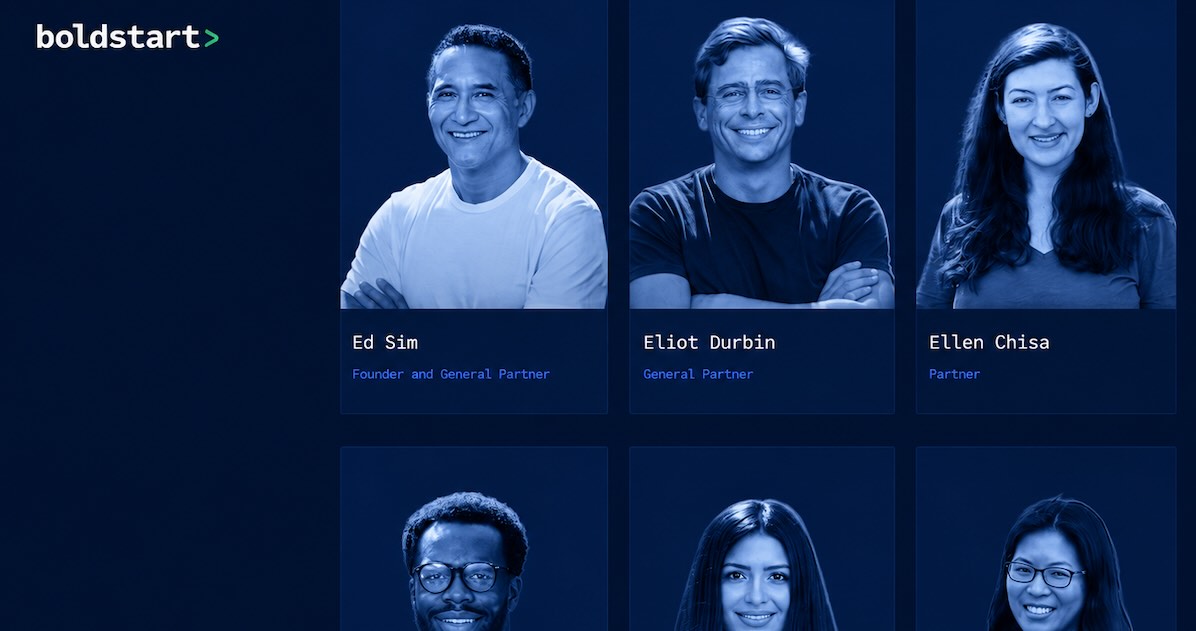
Founder and General Partner Ed Sim has described the model as deliberately concentrated, with the firm expecting to work closely with a relatively small number of founding teams each year.
That matters because the earliest stage of an AI company can look very different from a traditional software startup.
A technical founder may have a research breakthrough, a prototype or simply an insight into how a new model or infrastructure layer could change an industry. Waiting for revenue, customer traction or a polished product can mean waiting until the biggest opportunity has already attracted competitors.
Boldstart's pitch is that its value comes from getting involved before that happens.
The Autonomous Enterprise Bet
The firm's current thesis centers heavily on what it calls the autonomous enterprise.
That includes AI-native infrastructure, cybersecurity, applications, identity systems and models designed to allow software agents to perform work that traditionally required human employees or conventional software workflows.
The distinction is important.
The first generation of enterprise AI largely focused on adding copilots and assistants to existing systems. The next generation could involve companies redesigning entire workflows around autonomous software.
Boldstart's portfolio reflects that thesis.
The firm has backed companies including Snyk, Clay, Protect AI, CrewAI and Tessl, spanning cybersecurity, sales and marketing infrastructure, AI security and agent-based software.
Protect AI was acquired by Palo Alto Networks for more than $700 million, while Snyk and Clay have reached multibillion-dollar valuations.
Those outcomes give Boldstart a track record it can point to as it makes increasingly early bets on AI.
Why the Day-Zero Strategy Matters Now
AI has compressed the timeline between idea and company formation.
Technical founders can use increasingly powerful models and developer tools to prototype products faster, test ideas with smaller teams and reach early customers with less capital.
That creates a potential advantage for investors willing to operate before traditional venture firms.
But it also creates a new problem: there may be less conventional evidence available when the investment decision is made.
There might be no meaningful revenue. There may not even be a finished product.
Instead, investors have to assess technical ability, market insight, speed of execution and whether a founder can attract the talent necessary to turn an early idea into a company.
That's where Boldstart believes its experience provides an advantage.
The firm isn't simply offering a check. Its model is built around helping founders find early customers, develop the company's initial story and build the infrastructure required to scale.
A Miami Venture Firm With a National AI Thesis
Boldstart's strategy also gives Miami something increasingly valuable in the national AI race: a venture firm with a genuine focus on technical AI founders.
Miami's startup ecosystem has historically been strongest in areas such as fintech, consumer technology, crypto and real estate technology. AI is broadening that picture.
The presence of an investor specifically focused on technical founders and AI infrastructure adds another layer to the ecosystem — one aimed much closer to the technological foundations of the AI economy.
Boldstart isn't positioning itself as a Miami-only investor. Its portfolio and ambitions are national and global.
But having a firm with this investment thesis operating from Miami matters.
Venture capital doesn't just follow startups. It helps create the networks, talent pipelines and early customer relationships that allow startup ecosystems to compound.
If more technical founders choose to build in South Florida, having investors prepared to meet them before the first product exists could become a meaningful competitive advantage.
—
What This Means for Miami
Boldstart's model is a useful signal for where Miami's AI ecosystem is heading.
The city's next phase of AI growth won't be defined only by companies relocating to South Florida or existing businesses adopting AI tools. It will also depend on whether Miami can produce and attract founders building the underlying technology.
Boldstart is betting that some of those founders will emerge at the earliest possible stage.
For Miami entrepreneurs, that creates a potentially important local source of capital and expertise. For investors and ecosystem builders, it reinforces a broader point: the competition to establish Miami as an AI hub is increasingly moving upstream, from funding companies that use AI to backing the technical founders building what comes next.