AI can now make the creative process dramatically faster.
That doesn't necessarily mean it can make people better at being creative.
That tension was on full display at a recent Miami Ad School panel about artificial intelligence and creativity, where most of the participants discussed increasingly powerful AI tools, while one experienced creative offered a distinctly less enthusiastic perspective.
"You have to have taste. You have to have an eye for design. You have to have a POV." - Peña Plaza
Juan Javier Peña Plaza, a creative at Gut, said he doesn't use much AI in his own work. He might use Gemini for a couple of comps, while his creative partner makes heavier use of tools such as Midjourney and Gemini.
His reason for holding back was revealing.
"At the end of the day, you still have to have the fundamentals," Peña Plaza said, according to The Drum. "You have to have taste. You have to have an eye for design. You have to have a POV" he told The Drum.
The implication is increasingly important for an advertising industry where generating something is becoming easy.
Knowing what is worth generating may be getting harder, not easier.
AI Is Collapsing The Creative Process
Other members of the Miami Ad School panel were considerably more enthusiastic about what AI is doing to advertising.
Bre Fernandez of Macías Miami described the current environment as disruptive, while Michael DeJesus of Gearhead called it limitless.
Benji Shaw, creative director at Praytell, focused on what he believes remains scarce: ideas.
That's because the mechanics of advertising production are changing quickly.
The traditional agency process could involve a creative team developing a concept, an art director producing a visual, a deck being assembled and the idea moving through multiple layers of an agency before reaching a client.
AI is compressing that process.
A single creative can increasingly develop an idea, produce a visual and send the result directly to a client or colleague.
Shaw described the change as a process in which a creative can concept, make the art and send it through WhatsApp without the traditional deck-heavy process.
Fernandez put the productivity potential even more starkly, describing a modern creative as increasingly capable of operating like a "10-person shop in one person."
That's an enormous productivity gain.
But it also creates a new expectation: if creatives can produce more, agencies and clients may simply expect more.
The Machine Still Needs A Director
The panel's more interesting argument wasn't really about whether AI can generate creative work.
It was about who decides whether that work is any good.
DeJesus described AI as a collaborator, but one still missing something human.
Prompting, in that sense, doesn't eliminate creative direction. It makes creative direction more important.
The quality of the output depends heavily on the quality of the direction going into the system.
Peña Plaza offered perhaps the sharpest formulation of the evening: "You want AI to learn from you. You don't want to learn from AI."
That distinction matters because the same models are increasingly available to everyone.
If agencies use identical tools, similar prompts and similar reference material, the efficiency gains could come with an unexpected downside: sameness.
DeJesus described this as a "Pinterest effect," where everyone draws inspiration from the same visual language until brands begin to look increasingly alike.
AI can make production cheaper and faster.
It cannot automatically give a brand a distinctive point of view.
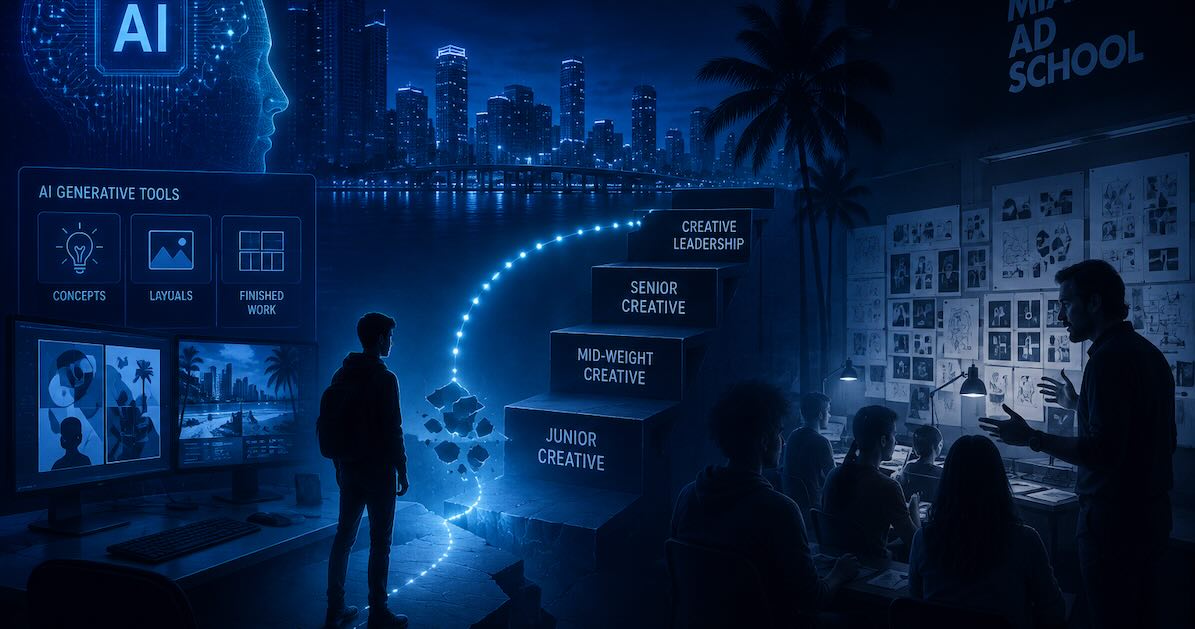
The Junior Creative Problem
The most consequential warning from the panel may have had little to do with the technology itself.
Fernandez raised concern that the advertising industry could become increasingly top-heavy as experienced creatives use AI to produce more work themselves.
The problem is straightforward.
Junior creatives have traditionally learned by doing the work that senior creatives eventually stop doing.
They develop judgment by producing mediocre ideas, receiving criticism, watching experienced colleagues work and gradually learning what makes an idea effective.
If AI allows a small number of senior creatives to handle much more production themselves, agencies may have less reason to hire juniors for those tasks.
That creates a potential talent-pipeline problem.
The industry could become more efficient in the short term while simultaneously making it harder to develop the people it will need in the future.
Why Friction Still Matters
That's where Peña Plaza's skepticism becomes particularly interesting.
His argument isn't that advertising should reject AI.
It's that some of the friction AI removes may actually be part of how creative people learn.
" It should be hard to think of ideas," Peña Plaza said. "It should be hard to create because that's how you learn. That's how good creative happens."
Thinking through difficult ideas takes time.
Creating bad work is part of learning how to create good work.
Having someone reject an idea forces a creative to understand why it failed.
If AI removes too much of that process, young creatives may become better at producing work before they have developed the judgment required to evaluate it.
That's a very different problem from AI simply replacing creative jobs.
It is a question of how an entire profession develops expertise.
What This Means For Miami
Miami is unusually well positioned to see this transition up close.
Miami Ad School is itself part of the city's creative ecosystem, while Miami's advertising, marketing, media and technology industries are increasingly intertwined with the city's broader startup economy.
The question raised by the panel therefore extends beyond advertising.
Miami's growing technology economy is increasingly built around a workforce expected to use AI to become more productive. But productivity gains can create their own workforce challenge if companies eliminate too many of the junior roles through which people traditionally acquire expertise.
For Miami agencies and startups, the lesson may be less about whether to use AI and more about how to use it without destroying the apprenticeship model underneath the industry.
AI can make one experienced creative dramatically more productive.
The harder question is whether it can help create the next experienced creative.
That may be one of the most important workforce questions in the AI economy.
Inspiration Source: The Drum, "The AI holdout: why Gut's Juan Javier Peña Plaza is resisting advertising's favorite new toy."
Read About The Debate and watch The Video At The Drum