Ask a financial advisor what's driving returns lately, and there's a good chance the answer starts with a handful of chipmakers, cloud providers and software companies riding the AI wave.
That concentration is becoming a story about the market itself.
Heading into 2026, AI-linked companies account for an outsized share of gains across major indexes. A relatively small group of firms building the infrastructure and software behind generative AI has become a major driver of benchmark performance, even as growth across the broader corporate economy remains less concentrated.
This isn't just a technology story anymore.
It's a portfolio management problem.
When a Few Stocks Carry the Index
Index funds and retirement accounts that track major benchmarks are increasingly exposed to the companies benefiting most from the AI buildout.
Investors who believe they own a broadly diversified basket of American companies may therefore have more exposure to a single technology cycle than they realize.
That's a meaningful shift in risk.
When a relatively small group of companies accounts for a large share of an index's returns, a significant pullback in those stocks can affect retirement accounts and institutional portfolios far more than headline index numbers suggest.
The debate over what happens next is less settled.
Some investors argue that the AI buildout — from data centers and chips to enterprise software — still has years of genuine revenue growth ahead, supporting elevated valuations.
Others warn that markets are already pricing in enormous future returns, leaving less room for disappointing earnings, slower adoption or weaker-than-expected demand.
The Valuation Question Nobody Can Fully Answer
Here's the tension underlying the entire debate: how much of today's AI spending will ultimately become durable corporate profit?
Companies across industries are pouring money into AI tools, infrastructure and data centers. But measuring the return on that spending remains difficult.
Some businesses are already reporting meaningful productivity gains and new revenue streams. Others are still experimenting, with the financial payoff harder to quantify.
That gap between market expectations and measurable business results is where much of the risk lies.
For long-term investors, the practical takeaway isn't necessarily to avoid AI exposure.
It's to understand how much exposure they already have.
An investor can own AI-heavy stocks directly while also holding them indirectly through index funds, target-date retirement accounts or actively managed portfolios.
That makes the more useful question less "Am I invested in AI?" and more "How much of my portfolio depends on the AI trade continuing to work?"
Concentration Changes the Risk
The issue becomes particularly important when strong recent performance creates the impression that diversification is working better than it actually is.
A rising benchmark can mask the fact that gains are being generated disproportionately by a small number of companies.
If those companies continue to outperform, concentration can look like a strength.
If the trade reverses, the same concentration can amplify losses.
That doesn't mean an AI correction is inevitable. It means investors need to distinguish between exposure to a powerful long-term technology trend and exposure to valuations that may already assume a great deal of future success.
For financial advisors, that distinction is becoming increasingly important.
What This Means for Miami
South Florida's investor base, from family offices and wealth managers to individual retirement savers, isn't immune to the concentration taking place in national markets.
Miami has become a growing hub for wealth management and fintech, and local advisors are likely to encounter clients whose portfolios have accumulated significant exposure to the same AI-related companies driving major indexes.
For Miami-based financial advisors and RIAs, that creates an important client conversation: how much AI exposure is enough, and how much is too much?
The issue is particularly relevant for investors who have accumulated large technology positions over several years and then moved to Florida without substantially changing their portfolios.
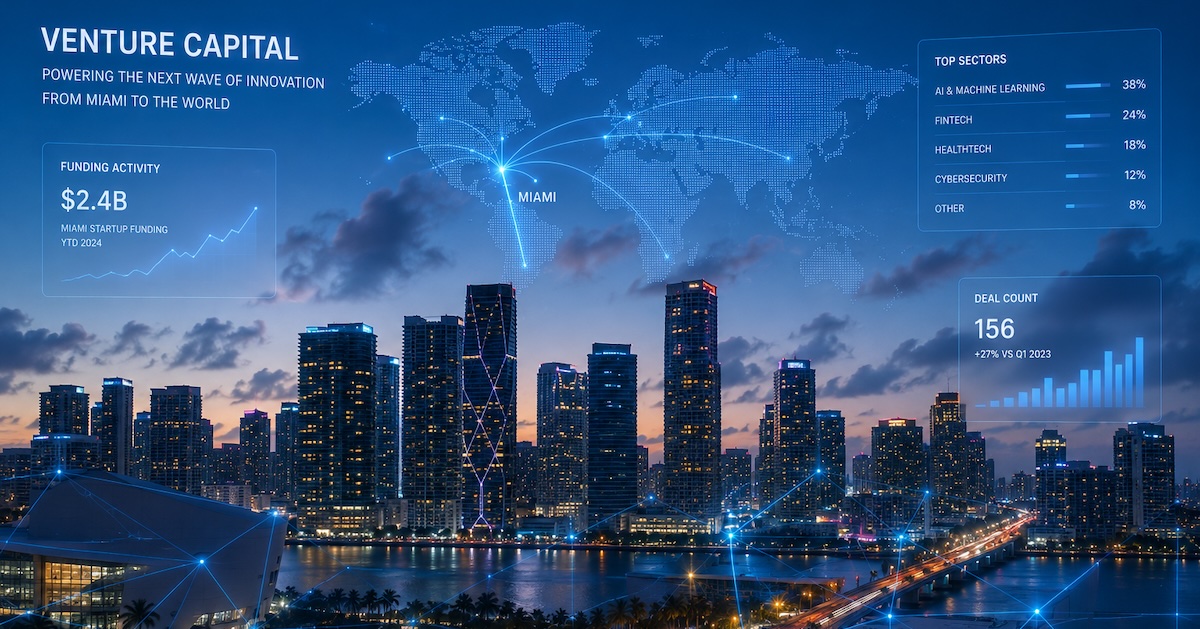
It also matters for Miami's startup and venture ecosystem.
If AI valuations eventually contract, investor sentiment toward AI-adjacent startups could tighten alongside the public markets. Companies with strong fundamentals may continue to attract capital, but speculative businesses could find fundraising significantly harder.
That creates a broader lesson for South Florida's growing technology economy.
AI may remain one of the most important investment themes of the decade. But the more capital markets depend on a relatively small group of AI winners, the more important it becomes to understand where the exposure actually sits — and what happens if the winners stumble.